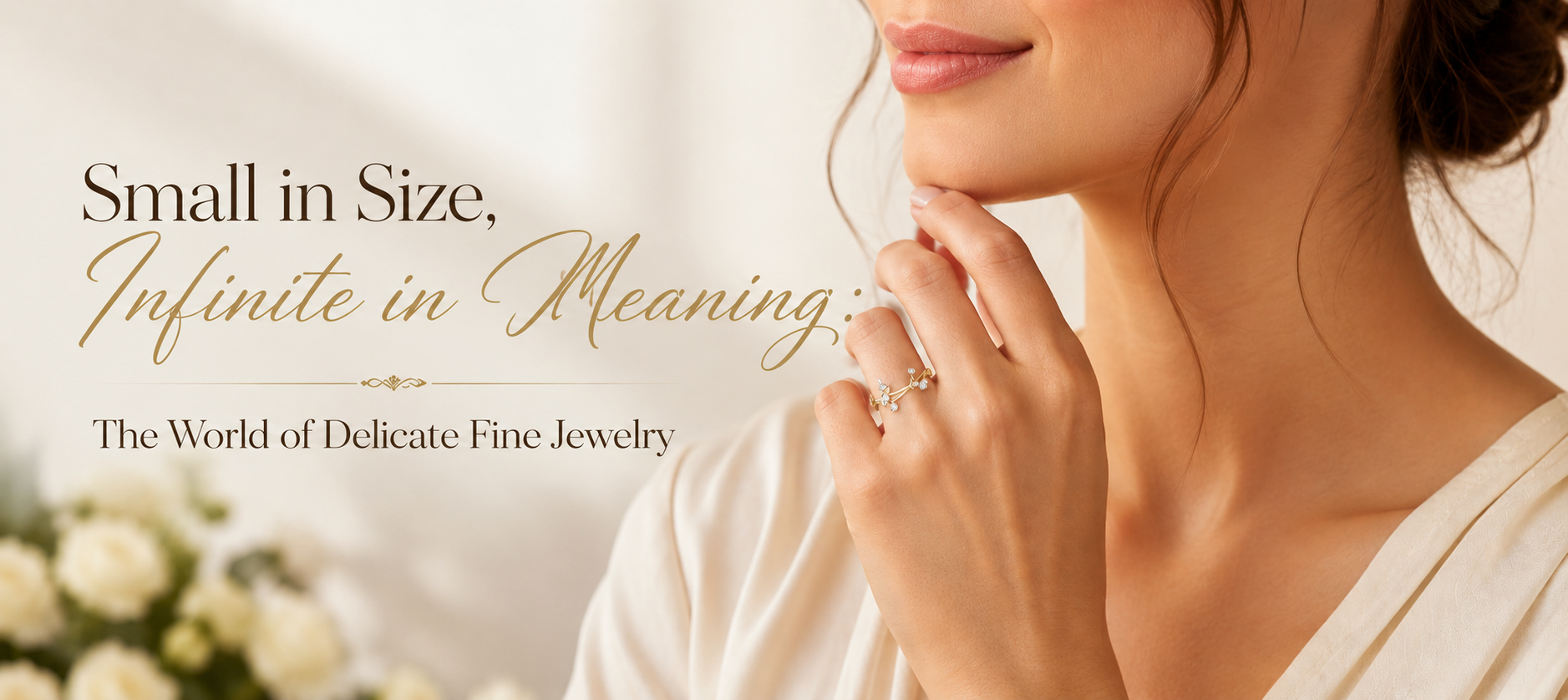
Small in Size, Infinite in Meaning: The World of Delicate Fine Jewelry
There is a quiet power in small things. A thin band of solid gold. A diamond no larger than a pinpoint of starlight. A constellation etched in 18K yellow gold and worn against the skin every morning. Delicate fine jewelry speaks without raising its voice — and that, perhaps, is why it endures.
Across the United States, a distinct shift is underway in how women think about and wear jewelry. The massive cocktail rings of previous decades have not disappeared, but they now share the conversation with something quieter and more personal: the rise of everyday fine jewelry as a meaningful, wearable luxury. This is not simply a fashion trend. It is a cultural movement toward intentionality — choosing jewelry that means something rather than jewelry that merely announces itself.
This guide explores the world of delicate fine jewelry in depth — what it is, why it matters, what distinguishes it from fashion jewelry, and how specific design categories like zodiac pieces, constellation necklaces, and petite rings have redefined what it means to wear something precious every single day.
What Does "Delicate Fine Jewelry" Actually Mean?
The term "delicate fine jewelry" is frequently used but rarely explained. In the jewelry world, it refers to pieces crafted from precious metals — most commonly solid 14K or 18K gold — and set with genuine gemstones or natural diamonds, but designed with a refined, lightweight silhouette rather than a heavy or ornate one.
The emphasis on delicate is not about fragility. On the contrary, solid gold is remarkably durable. The word instead describes the visual language of the piece: slender bands, open settings, minimal material presence, and a design aesthetic that feels like a whisper rather than a shout.
This is distinct from fashion jewelry or costume jewelry in a fundamental way. Fashion jewelry may look similar on the surface, but it is constructed from base metals with gold plating — a coating that fades, discolors, and deteriorates over months. Delicate fine jewelry, by contrast, retains its color, structure, and beauty indefinitely with basic care, making it a sound investment as well as a personal statement.
Quick distinction: Fine jewelry uses solid precious metals (14K/18K gold, platinum) and genuine gemstones. Fashion jewelry uses plated metals and synthetic stones. The difference is not visible at first glance — it becomes clear over years of wear.
The Case for Wearing Fine Jewelry Every Day
One of the most significant evolutions in American jewelry culture over the past decade has been the normalization of wearing genuine fine jewelry as a daily practice — not just for special occasions. This behavioral shift reflects changing values around self-expression, personal investment, and what luxury means in everyday life.
Everyday fine jewelry is built around the concept of wearability. Pieces designed for daily use tend to share certain characteristics: they are lightweight enough to be forgotten on the body, durable enough to survive the demands of an active lifestyle, and versatile enough to transition from a morning meeting to an evening dinner without a wardrobe change.
The practical benefits of solid gold fine jewelry become apparent over time. Unlike plated alternatives, solid 14K or 18K gold pieces do not require removal before showering, do not tarnish with exposure to moisture or skin oils, and maintain their surface integrity for decades. Many women who own high-quality fine jewelry describe the experience of wearing the same ring or necklace for years — and having it look identical to the day they received it.
“Fine jewelry designed for every day is not about making a statement. It is about becoming part of you.”
Beyond the material benefits, there is a psychological dimension to daily fine jewelry that is worth naming. Wearing something beautiful and genuine — a ring that carries your birthstone, a necklace that maps your zodiac constellation — creates a quiet, recurring ritual of self-acknowledgment. In a culture that often deprioritizes personal care, this small act carries real weight.
Zodiac and Astrology Jewelry: When Stars Become Heirlooms
Astrology-inspired jewelry is one of the fastest-growing categories in the fine jewelry market, and it is not difficult to understand why. In a world where many people are searching for meaning, identity anchors, and ways to express who they are without words, zodiac symbols offer a ready vocabulary. They are widely recognized, deeply personal, and visually compelling.
What separates zodiac fine jewelry from the casual astrology-themed products that flood mass markets is the medium. When a Taurus constellation is rendered in solid 18K gold — when its stars are marked with natural diamonds, its lines drawn in precious metal — it ceases to be decorative and becomes something genuinely meaningful. The craftsmanship elevates the symbolism.
Choosing the Right Zodiac Ring for Your Sign
Earth signs like Taurus tend to favor grounded, classic designs with timeless stone settings. If you are a Taurus, a well-crafted pair of taurus diamond rings — designed around the constellation’s elegant V-shape and set with natural diamonds — reflects the sign’s appreciation for beauty, permanence, and craftsmanship.
Air signs, meanwhile, often gravitate toward more unconventional silhouettes. Aquarius engagement rings in fine gold capture the sign’s forward-thinking, individualistic nature — clean geometric forms with a celestial sensibility that feels both modern and timeless. For a sign known for resisting convention, the ability to wear a ring that genuinely reflects personal identity is deeply satisfying.
Fire signs bring their own energy to fine jewelry. Aries, the first sign of the zodiac, is associated with boldness, leadership, and action. A fire sign does not whisper — and neither do the best pieces designed around its imagery. Well-crafted aries constellation jewelry captures that assertive spirit through strong lines, meaningful gem placement, and a presence that speaks even in a petite form factor.
Constellation Necklaces: Carrying the Sky With You
Among all formats of zodiac-inspired fine jewelry, constellation necklaces occupy a particularly beloved place. Unlike a ring or earring, a necklace rests at the center of the chest — close to the heart, visible to others, but easily hidden beneath a collar when desired. This duality between public expression and private meaning makes it one of the most emotionally resonant jewelry categories available.
A genuine fine jewelry constellation necklace maps the actual star positions of a zodiac sign onto a pendant in solid gold. Each star in the constellation is typically marked with a small natural diamond or gemstone, creating a piece that is simultaneously astronomically accurate and visually beautiful. The result is a necklace that carries personal meaning without requiring any explanation.
For fire signs, an aries constellation necklace offers an especially striking visual — the ram’s bold, triangular star pattern translates beautifully into pendant form, with each diamond catching light at a different angle as the wearer moves.
Layering tip: Constellation necklaces layer exceptionally well with thin chains at different lengths. A zodiac pendant at 18 inches paired with a plain diamond bar necklace at 16 inches and a delicate birthstone pendant at 20 inches creates a curated, personal look that feels editorial rather than busy.
The Art of Petite Rings: Understated Luxury in Miniature
The word "petite" in jewelry does not mean diminished. It means concentrated. A well-executed petite ring in solid gold contains as much craftsmanship as a bolder piece — the same metal purity, the same precision setting, the same attention to finish and proportion — in a silhouette designed to feel effortless and intimate rather than declarative.
Petite rings have become the cornerstone of the modern stacking aesthetic. Rather than wearing one statement ring on one finger, contemporary fine jewelry wearers layer two, three, or five rings across multiple fingers — mixing textures, metal finishes, gemstone colors, and shapes to create a curated look that is entirely their own. The key to successful stacking is starting with petite, well-proportioned pieces that coexist harmoniously.
What Makes a Petite Ring "Fine"?
Not all small rings are created equally. A petite fine jewelry ring is defined by: solid precious metal construction (never hollow or plated), genuine natural stones or diamonds, precise prong or bezel settings that secure stones reliably, and a surface finish that holds up to daily contact. The ring band should feel substantial in the hand despite its slim visual profile — a sign of quality metal density and construction integrity.
When shopping for petite everyday fine jewelry, the question to ask is not "how small is it?" but rather "how well is it made?" A 1.5mm solid 14K gold band with a single natural diamond is infinitely more valuable — materially and experientially — than a wider plated ring with a synthetic stone.
Zodiac Engagement Rings: Where Personal Meaning Meets a Milestone
An engagement ring is, by definition, a piece of jewelry that carries extraordinary personal weight. It is worn every day for decades. It is seen by everyone who knows the wearer. It marks one of the most significant moments in a person's life. Given all of this, the case for a zodiac-inspired engagement ring — one that reflects not just love but identity — is compelling.
Sagittarius, the fire sign associated with adventure, optimism, and philosophical depth, produces one of the most interesting briefs for engagement ring design. Sagittarius engagement rings tend to feature celestial motifs, arrowhead imagery, and expansive, open designs that mirror the sign’s eternal sense of possibility. A ring that reflects these traits does not just represent a commitment — it represents the whole person.
The broader category of zodiac engagement rings invites a more thoughtful approach to one of life’s most personal purchases. Rather than defaulting to the conventional solitaire because it is expected, couples increasingly choose designs that carry genuine meaning — designs that will tell a story for as long as the ring is worn.
“The best engagement ring is the one that could only belong to you.”
Materials Matter: Why Solid Gold and Natural Diamonds Are Non-Negotiable
In the context of delicate fine jewelry, the choice of materials is not a luxury preference — it is a foundational requirement. Two categories of material — solid gold and natural diamonds — determine whether a piece qualifies as fine jewelry at all, and significantly impact both the sensory experience of wearing it and its long-term value retention.
Understanding Gold Karats
Gold karats measure the percentage of pure gold in an alloy. 24K is pure gold — too soft for practical jewelry. 18K gold is 75% pure gold mixed with 25% alloying metals (typically silver, copper, or zinc), producing a metal that is rich in color, highly durable, and resistant to tarnishing. 14K gold is 58.3% pure gold, offering excellent durability at a slightly more accessible price point, with a color that is marginally lighter than 18K.
Both 14K and 18K are appropriate for fine jewelry intended for daily wear. Neither will discolor, tarnish, or deteriorate with regular use. The choice between them is largely aesthetic — 18K carries a warmer, richer color, while 14K offers slightly greater scratch resistance due to its higher alloy content.
Natural Diamonds vs. Lab-Grown: What Buyers Should Know
The contemporary jewelry market includes both natural and lab-grown diamonds. Both are chemically identical — carbon atoms arranged in the same crystal structure. The distinction lies in their origin and, in many cases, their long-term resale value. Natural diamonds retain scarcity value over time; lab-grown diamonds have seen significant price reductions as production scales. For everyday fine jewelry intended as an heirloom or investment, natural diamonds remain the traditional choice.
How to Build a Personal Fine Jewelry Collection Over Time
A meaningful fine jewelry collection is not assembled in a day. It is built gradually, intentionally — one piece at a time, each chosen for a specific reason. Understanding how to approach this process helps buyers make purchases they will never regret.
Start with Anchor Pieces. An anchor piece is a foundational item that you will wear nearly every day, regardless of outfit or occasion. A plain gold band, a delicate diamond necklace, or a petite birthstone ring serves this function well. Choose your anchor piece in solid 14K or 18K gold and ensure it fits your aesthetic before adding anything else.
Add Symbolic Pieces Gradually. Once your anchors are in place, begin adding pieces with personal meaning. A zodiac constellation necklace, a birthstone ring, or a star-map pendant aligned to a meaningful date. These pieces give your collection narrative depth — they make it yours rather than a generic accumulation of jewelry.
Think in Terms of Layering and Stacking. Fine jewelry speaks loudest in combination. A single petite ring is beautiful; three petite rings stacked on the same finger are arresting. A single necklace is elegant; three necklaces at staggered lengths are editorial. Buy pieces that coexist — similar metal tones, complementary scales.
Prioritize Quality Over Quantity. Five pieces of genuine fine jewelry crafted in solid gold are more valuable — practically and emotionally — than twenty pieces of plated jewelry that will fade within a year. The investment mindset matters in fine jewelry as much as in any other luxury category.
The journey of building a collection of everyday fine jewelry is, ultimately, an exercise in self-knowledge. Each piece you choose reflects something true about you. Over time, the collection becomes a portrait.
Gifting Delicate Fine Jewelry: Getting It Right Every Time
Fine jewelry is one of the most consistently meaningful gifts a person can give or receive. Unlike consumable gifts or experiences that end, a piece of fine jewelry persists — it is worn, displayed, and remembered indefinitely. This is precisely what makes it both powerful and demanding as a gift choice.
The most successful fine jewelry gifts tend to be personalized. A ring that maps the recipient’s zodiac sign. A birthstone necklace in their birth month’s gem. A constellation pendant aligned to their sign’s star pattern. Personalized fine jewelry communicates that the giver paid attention — that they saw the recipient and chose something specifically suited to them.
For birthdays, the obvious choice is birthstone jewelry — but consider elevating the category. Rather than a commercial birthstone pendant in plated silver, choose a birthstone set in solid 14K gold with a natural diamond accent. The materials transform the gesture from casual to significant.
For engagements and anniversaries, zodiac-inspired fine jewelry offers a uniquely personal alternative or complement to traditional options. An engagement ring designed around a person’s constellation, or an anniversary band incorporating meaningful gemstones, tells a story that a generic design cannot.
The Enduring Significance of Small, Beautiful Things
Delicate fine jewelry endures because it sits at the intersection of artistry, material value, and personal meaning. It is small in scale but infinite in what it carries — identity, memory, belief, love. In a world saturated with disposable products and fast-moving aesthetics, a piece of handcrafted fine jewelry represents a counter-offer: something made to last, designed with intention, and worn with purpose.
Whether you are drawn to zodiac rings that reflect your astrological identity, constellation necklaces that map the stars above your birth date, petite stacking rings that speak through their restraint, or zodiac-inspired engagement rings that honor who you are as much as who you love — the category of everyday fine jewelry offers a language for self-expression that grows richer the longer you wear it.
The best piece of fine jewelry you own is not the most expensive. It is the one you reach for every morning without thinking — the one that has become, quietly and irrevocably, part of who you are.
Frequently Asked Questions
What is the difference between fine jewelry and fashion jewelry?
Fine jewelry is crafted from solid precious metals — typically 14K or 18K gold — and set with natural gemstones or genuine diamonds. It is designed for long-term wear, holds intrinsic material value, and often becomes an heirloom. Fashion (or costume) jewelry uses base metals with a thin gold plating and synthetic stones. The plating on fashion jewelry fades over months of wear, while solid gold fine jewelry retains its color and quality indefinitely with basic care.
Can delicate fine jewelry be worn every day without damage?
Yes — this is precisely what everyday fine jewelry is designed for. Pieces crafted in solid 14K or 18K gold are durable enough for daily wear, including exposure to water, hand creams, and regular activity. Petite rings, thin gold bands, and lightweight constellation necklaces are built to be worn continuously. Basic care — occasional gentle cleaning and avoiding harsh chemicals — is all that is required to maintain their condition over decades.
Why is zodiac jewelry considered meaningful as fine jewelry?
Zodiac jewelry gains its significance from the combination of personal identity and precious craftsmanship. When an astrological symbol — a Taurus constellation, an Aries ram motif, an Aquarius water-bearer — is rendered in solid gold and set with natural diamonds, it transcends decoration and becomes a wearable expression of personality and story. The use of fine materials elevates the symbolism from novelty to heirloom.
How do I choose a zodiac engagement ring that matches my sign?
The key is matching the design language of the ring to the core traits of the sign. Earth signs like Taurus favor timeless, grounded settings with classic proportions. Air signs like Aquarius are drawn to unconventional silhouettes and geometric clarity. Fire signs like Aries and Sagittarius gravitate toward bold imagery, strong lines, and celestial motifs. Working with a jeweler who understands astrological symbolism and translates it into solid-gold fine jewelry design ensures the ring reflects both the sign and the individual.
Are petite rings suitable for all hand sizes?
Petite rings are flattering across all hand sizes, though they are especially complementary to delicate or slender fingers. For those who prefer understated jewelry, or who want to build a stackable collection, petite fine jewelry rings are the ideal starting point. Their subtle scale makes them highly versatile — equally at home in a professional setting, casual daily wear, or a dressed-up evening look. The key is choosing petite rings crafted in solid gold with genuine stones so the quality is apparent regardless of the scale.
-
How to Find a Reliable Wholesale Jewelry Supplier in the USA: A Retailer’s Guide
September 29th, 2026 -
 August 22nd, 2026
 -
 August 22nd, 2026
 -
 July 9th, 2026