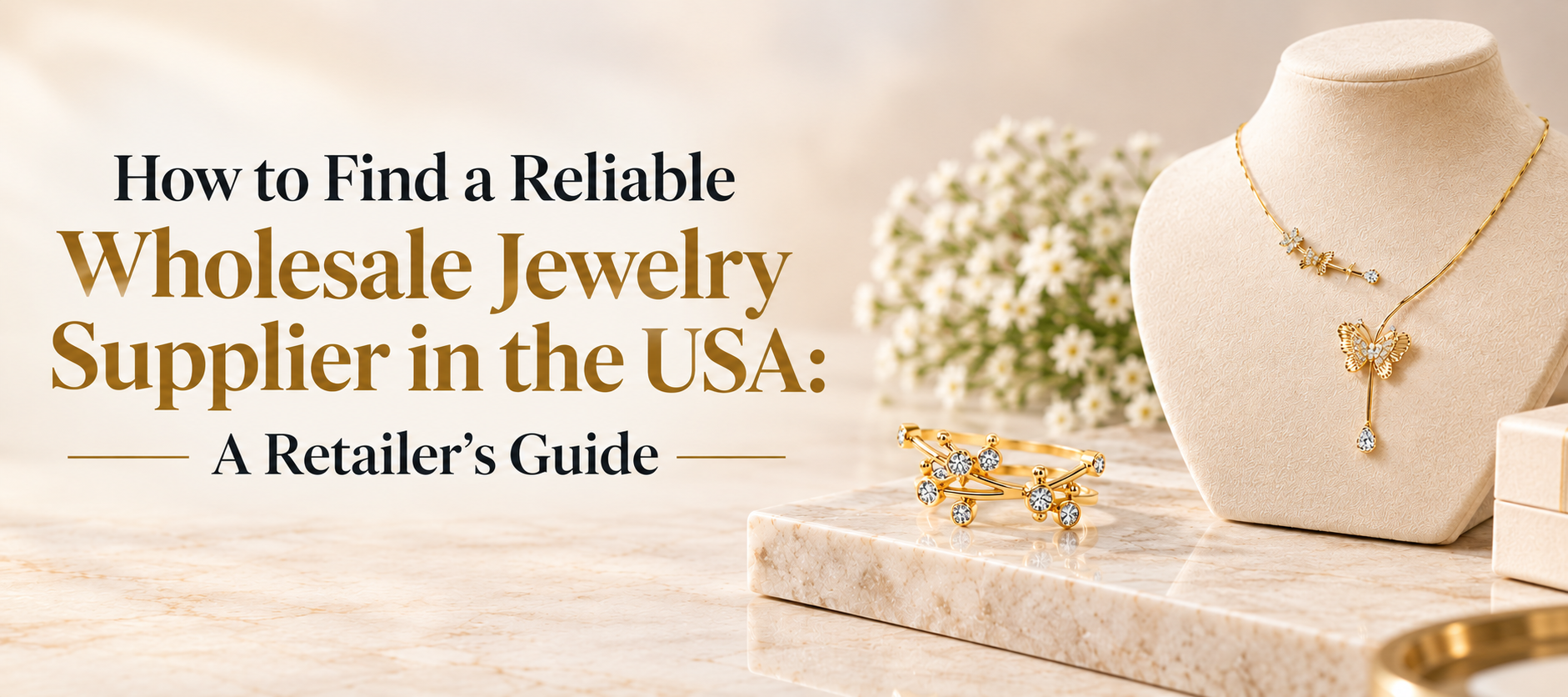
How to Find a Reliable Wholesale Jewelry Supplier in the USA: A Retailer’s Guide
Finding a reliable wholesale jewelry supplier in the USA is one of the most important decisions a jewelry retailer can make. Your supplier affects product quality, pricing, inventory availability, delivery timelines, and ultimately the experience you provide to your customers. Whether you operate a jewelry boutique, an independent store, or an online jewelry brand, the right supplier should offer more than attractive designs and competitive prices. You need a partner that can provide consistent quality, clear communication, dependable production, and products that fit your customers and brand. Here are the key factors to consider before choosing a wholesale jewelry supplier.
What Makes a Wholesale Jewelry Supplier Reliable?
A reliable jewelry supplier should be transparent about its materials, pricing, minimum order requirements, production process, and delivery timelines. It should also be able to maintain consistent quality when you reorder products.
For retailers, reliability means being able to purchase products with confidence and know that the jewelry will meet the specifications agreed upon. Before opening a wholesale account, look beyond the product catalog. Research the supplier's experience, manufacturing capabilities, customer service, customization options, and ability to support repeat orders.
1. Research the Supplier’s Experience
Start by learning about the supplier's background and experience in the jewelry industry. Look for information about its history, design capabilities, manufacturing process, and the types of businesses it serves.
A supplier with established jewelry expertise may have a better understanding of materials, gemstone setting, finishing, production requirements, and the needs of retail businesses. You should also check whether the supplier participates in recognized jewelry trade shows or maintains an established presence within the industry. These details can help you understand the supplier's professional experience before you place an order.
2. Verify Jewelry Materials and Gold Purity
Material transparency is essential when purchasing fine jewelry for resale.
If you are sourcing gold jewelry, confirm whether the pieces are solid gold, gold-filled, or gold-plated. Ask for the exact karat, such as 10K, 14K, or 18K, and make sure the information is clearly provided on product descriptions and order documents.
For gemstone jewelry, ask about the type of gemstone, treatments when applicable, and any available documentation. For diamond jewelry, retailers should understand the stone specifications and determine whether grading documentation is appropriate for the products they are purchasing.
Clear material information allows you to describe products accurately to your customers and make purchasing decisions based on facts rather than assumptions.
3. Evaluate Product Quality Before Buying in Bulk
Never judge a supplier only by photographs.
Whenever possible, request samples before committing to a large wholesale order. Examine the jewelry carefully for finishing, stone security, dimensions, clasps, polish, construction, and overall craftsmanship.
Consistency is particularly important for retailers. If a particular style becomes a bestseller, you should be able to reorder it without significant differences in appearance or quality. A supplier that maintains quality-control procedures can help reduce defective products, returns, and customer complaints.
4. Compare Minimum Order Quantities and Pricing
Minimum order quantity, or MOQ, is another important consideration for jewelry retailers. Suppliers may have different requirements depending on the product, materials, customization, and production process.
Before ordering, ask about:
- Minimum order quantities
- Wholesale pricing
- Sample costs
- Bulk pricing
- Payment terms
- Customization costs
- Shipping charges
- Return or replacement policies
Do not automatically choose the supplier offering the lowest price. The cheapest option may not provide the quality, service, customization, or consistency your business needs. Instead, compare the overall value of the supplier and determine whether the products support your desired retail price and customer expectations.
5. Check Production Capacity and Lead Times
Reliable inventory depends on predictable production.
Ask whether products are ready to ship or made to order, how long production typically takes, and whether custom orders require additional time. You should also understand how the supplier handles larger orders and repeat purchases.
This becomes especially important before holidays, seasonal launches, bridal promotions, and other periods when jewelry demand can increase. A dependable supplier should communicate realistic timelines rather than promising delivery dates that cannot consistently be met.
6. Consider Customization and Private-Label Capabilities
Many U.S. jewelry retailers and emerging brands want products that are different from mass-market designs. If exclusivity is important to your business, ask whether the supplier provides customization or private-label services.
Customization may include:
- Gold karat or metal color
- Gemstone selection
- Stone size or carat weight
- Design modifications
- Product dimensions
- Branding
- Packaging
Ask the supplier how the design approval process works and whether you can provide sketches, reference images, or existing designs.
For retailers building a private-label collection, clarify design ownership, production requirements, minimum quantities, revisions, and lead times before production begins.
7. Review the Supplier’s Jewelry Collection
Your supplier's product range should match your target customers and retail positioning.
For example, a boutique specializing in everyday fine jewelry may need versatile rings, earrings, necklaces, and bracelets. A retailer targeting premium customers may require diamond and gemstone pieces with higher-value materials and distinctive designs.
Rekiya Designs offers collections across diamonds, gemstones, zodiac jewelry, birthstones, emeralds, petite styles, enamel, and other fine-jewelry categories. Its wholesale assortment includes rings, necklaces, earrings, and bracelets, giving retailers multiple categories to consider when building an assortment.
If your customers are specifically looking for colored gemstones, reviewing a supplier's Wholesale Gemstone Jewelry assortment can help you determine whether its designs and stone selection align with your store.
8. Assess Communication and Customer Support
Communication is easy to overlook until an order has a problem.
Before placing a large order, pay attention to how the supplier answers your questions. Are product specifications clear? Are pricing and MOQs explained? Can someone provide updates about production or shipping?
Ask how the supplier handles:
- Order changes
- Damaged or defective products
- Delays
- Repairs or replacements
- Shipping updates
- Custom orders
- Reorders
For a retailer, responsive communication can make inventory planning much easier.
9. Look for Manufacturing Expertise
There is an important difference between buying from a company that simply resells jewelry and working with a business that has manufacturing or production expertise. A Designer Jewelry Manufacturer may be able to provide greater flexibility around materials, designs, gemstones, and production specifications.
Rekiya Designs states that its manufacturing operation works across design, casting, stone setting, and finishing, with customization available for retailers and brands. When evaluating any manufacturer, ask where the jewelry is produced, which stages are handled directly, what can be customized, and how quality is checked before products are shipped.
10. Start With a Trial Order
A trial order is one of the most practical ways to evaluate a potential supplier.
Instead of immediately committing to a large inventory purchase, begin with a manageable order when the supplier's terms allow it. Use the experience to evaluate:
- Product quality
- Order accuracy
- Packaging
- Delivery time
- Communication
- Documentation
- Customer support
If the supplier meets your expectations, you can gradually increase your order volume and establish a longer-term purchasing relationship.
Questions to Ask a Wholesale Jewelry Supplier
Before placing your first order, ask these questions:
- What materials and gold karats do you offer?
- What is your minimum order quantity?
- Can I request samples before ordering in bulk?
- What are your standard production timelines?
- Do you offer custom jewelry or private-label services?
- Can I reorder successful designs?
- How do you maintain quality consistency?
- What gemstone and diamond options are available?
- What are your shipping and return policies?
- Who should I contact for order support?
Clear answers to these questions can help you compare suppliers objectively and identify potential issues before they affect your inventory.
Build Your Wholesale Jewelry Assortment With Confidence
Choosing a reliable jewelry supplier is about more than finding attractive products at a good price. U.S. retailers should consider material quality, craftsmanship, production capacity, MOQs, customization, communication, and the supplier's ability to support repeat orders.
For retailers specializing in diamonds, evaluating a supplier's Wholesale Diamond Jewelry collection can also help determine whether its designs, materials, and product range fit your customers.
The goal is to find a supplier that can support your business beyond a single order. A strong wholesale relationship should make it easier to maintain quality, replenish successful products, introduce new collections, and serve your customers with confidence.
By researching suppliers carefully, requesting samples, asking the right questions, and starting with a trial order, retailers can make more informed purchasing decisions and build a dependable jewelry supply chain for long-term growth.
-
 August 22nd, 2026
 -
 August 22nd, 2026
 -
 July 9th, 2026
 -
How to Invest in Jewelry That Actually Holds Its Value Over Time
June 22nd, 2026