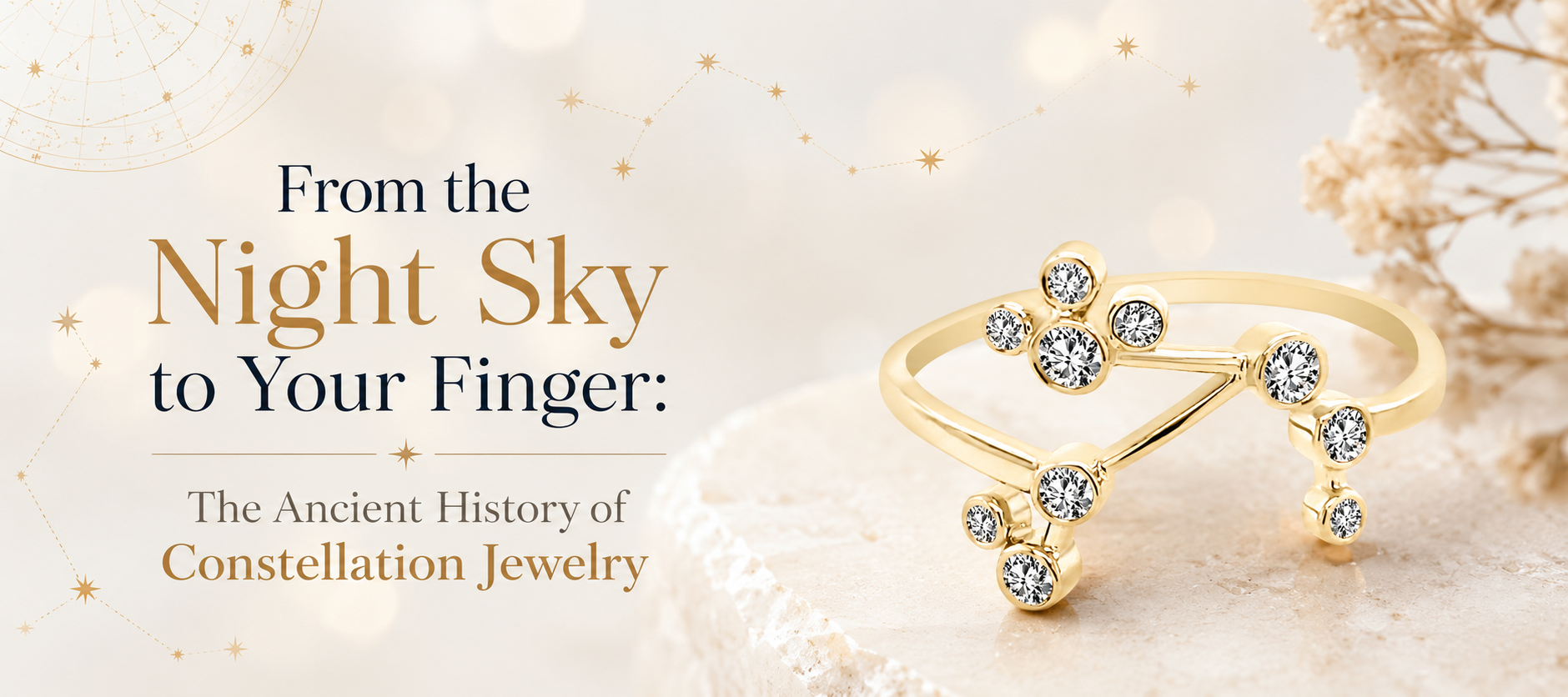
From the Night Sky to Your Finger: The Ancient History of Constellation Jewelry
There is something quietly extraordinary about slipping a ring onto your finger and knowing that the design engraved in gold has been worn — in some form — for more than five thousand years. Constellation jewelry is not a trend. It is a tradition so old it predates written language, predates organized religion in many cultures, and in some civilizations, predates the wheel.
The stars were humanity's first map, calendar, compass, and spiritual guide — and people have been translating that awe into wearable art ever since.
This is the complete story of how the night sky became the most enduring design inspiration in the history of fine jewelry. From ancient Babylonian cylinder seals to today's handcrafted solid gold constellation rings set with natural diamonds, the journey spans every major civilization on Earth.
By the time you finish reading, you will understand not just where these pieces come from, but why wearing one feels so profoundly personal.
“The stars were humanity's first map, first calendar, and first source of wonder. Constellation jewelry is the oldest form of wearable storytelling.”
Why Humans Have Always Connected Stars to Adornment
Long before we had electric light, the night sky was impossible to ignore. For ancient peoples living without artificial illumination, the stars were vivid, overwhelming, and ever-present. They rose and set on a reliable schedule. They marked the seasons for planting and harvest. They guided sailors across featureless oceans and helped nomadic tribes navigate deserts.
In a world full of unpredictable dangers, the stars were something a person could count on.
It is no coincidence that the very first instinct humans had when they identified a meaningful star pattern was to recreate it — on cave walls, on pottery, on stone seals, and eventually, on their own bodies. Anthropologists call this practice "sympathetic symbolism": the belief that wearing or displaying the image of something powerful transfers some of that power to the wearer.
The stars were the most powerful thing in the sky. Naturally, humans wanted to carry them.
This is the fundamental psychological root of the constellation jewelry history we will trace through the ages. The specifics change with each civilization, but the emotional impulse remains completely consistent: wear the stars to feel connected to something larger, older, and more permanent than yourself.
A Journey Through Time: How Every Great Civilization Wore the Stars
The timeline of star-inspired jewelry is essentially a timeline of human civilization itself. Each era added new meaning, new materials, and new artistry — but none of them abandoned the core idea.
Here is the full arc.
c. 3000 BCE — Mesopotamia
The Birthplace: Babylonian Star Maps and Cylinder Seals
The oldest evidence of humans systematically identifying and naming star patterns comes from Mesopotamia — the fertile region between the Tigris and Euphrates rivers, in what is now Iraq.
Babylonian astronomers were meticulous observers. They tracked planetary movements, lunar cycles, and the rising of specific star clusters with a precision that still impresses modern astronomers. By around 3000 BCE, they had identified and named several of the same constellations we recognize today, including Leo, Taurus, and Scorpius.
Babylonian artisans carved cylinder seals — small stone rollers used to press designs into clay — that featured these star patterns alongside protective deity imagery. Wealthy individuals wore these seals as amulets.
This is arguably the earliest documented form of constellation-inspired jewelry: wearable objects engraved with star patterns, carried as personal protection and status symbols.
The zodiac as we know it — twelve signs corresponding to the sun's apparent path through specific star clusters — was formalized by Babylonian astronomers around 500 BCE, and immediately began appearing on personal adornments, rings, and pendants.
c. 3000–30 BCE — Ancient Egypt
Gold, Gods, and the Eternal Stars of Egypt
In ancient Egypt, the stars were not merely navigational tools — they were divine. Egyptian cosmology placed the gods themselves within specific star clusters.
Osiris was associated with Orion. Isis was linked to Sirius, the brightest star in the night sky. The Milky Way was understood as a celestial river, mirroring the Nile that sustained Egyptian civilization.
Pharaohs commissioned spectacular jewelry featuring these star associations — golden pectorals inlaid with lapis lazuli to represent the night sky, scarab amulets aligned with stellar symbolism, and elaborate collar pieces that mapped divine star territories across the chest of the wearer.
Gold was the obvious material of choice. In Egyptian theology, gold was literally the flesh of the gods — it did not tarnish, it caught the light of the sun, and it lasted forever.
Pairing the permanence of gold with the eternity of stars was not just aesthetically beautiful; it was theologically coherent.
This tradition of using gold specifically for celestial jewelry persists to this day in modern fine jewelry, including handcrafted gold constellation pieces created by contemporary designers.
c. 800 BCE–400 CE — Ancient Greece & Rome
Mythology, Mathematics, and the First Zodiac Rings
The Greeks were the great storytellers of the constellation world. Where Babylonians catalogued and Egyptians deified, the Greeks mythologized.
Every constellation acquired a story: Orion was a great hunter placed among the stars by Zeus; Cassiopeia was a vain queen condemned to orbit the celestial pole for eternity; the Pleiades were seven sisters transformed into stars.
These narratives made constellations emotionally accessible and personally relatable in a way pure astronomy never could.
Greek jewelers, particularly in the Hellenistic period following Alexander the Great's conquests (323–31 BCE), produced stunning gold rings engraved with zodiac symbols.
Archaeological excavations have recovered genuine gold zodiac rings from this period — physical artifacts proving that wearing your birth sign in precious metal is a tradition with over two thousand years of continuous history.
Roman jewelers inherited and expanded this tradition. Roman soldiers wore zodiac amulets in the field. Roman aristocrats commissioned personalized birth charts in gold.
The practice became so widespread that Roman texts from the first century CE describe specific gemstone combinations believed to amplify each sign's strengths.
c. 600–1500 CE — The Islamic Golden Age & Medieval Europe
Astrolabes, Alchemy, and the Preservation of Celestial Craft
After the fall of the Western Roman Empire, the Islamic world became the primary custodian of astronomical and astrological knowledge.
Scholars at the great libraries of Baghdad, Cairo, and Córdoba translated, expanded, and refined the celestial traditions of Babylon, Greece, and Persia.
Islamic craftsmen produced some of the most technically sophisticated constellation-based instruments ever made — particularly the astrolabe, a handheld brass device mapping the night sky that was also, unmistakably, a beautiful object.
Many astrolabes were made in miniature, worn as pendants, functioning simultaneously as scientific instruments and pieces of fine jewelry.
In medieval Europe, astrology was considered a legitimate branch of medicine and philosophy. Court astrologers advised kings. Physicians consulted star charts before prescribing treatments.
Jewelers crafted "zodiacal rings" — rings with the twelve signs arranged in sequence — worn as protective talismans.
The belief that your birth sign influenced your health, temperament, and fortune made wearing zodiac jewelry deeply practical, not merely decorative.
1400–1800 CE — Renaissance, Baroque & Enlightenment
When Science and Celestial Jewelry Coexisted Beautifully
The Renaissance brought renewed fascination with classical antiquity — including classical celestial traditions.
Renaissance jewelers combined Greco-Roman zodiac imagery with newly precise astronomical knowledge, producing elaborate enamel and gold pieces depicting the twelve signs alongside their ruling planets.
Portraits from the 16th and 17th centuries regularly show noble sitters wearing rings and pendants featuring their astrological sign, demonstrating that celestial jewelry was a mark of intellectual sophistication, not mere superstition.
Even as the Scientific Revolution began shifting understanding of the cosmos — Copernicus, Galileo, and Kepler progressively dismantling the earth-centric universe — the emotional and aesthetic appeal of celestial jewelry never wavered.
By the Baroque period, the night sky had become a reliable design motif for Europe's finest jewelers.
Star-shaped brooches, crescent moon earrings, and zodiac rings remained consistent elements of aristocratic jewelry collections through the 18th century.
1800s–1960s — Victorian, Art Nouveau & Retro
Stars, Sentimentality, and the Language of Personal Jewelry
The Victorian era transformed jewelry into a language of emotion. Queen Victoria herself popularized star-motif jewelry following Prince Albert's death in 1861, when mourning jewelry featuring star and crescent designs became fashionable across Britain and America.
Stars symbolized the eternal, the unreachable, and the beloved who had passed beyond ordinary reach.
Star brooches, star pins, and celestial lockets became the sentimental jewelry of an entire generation.
Art Nouveau (1890–1910) brought celestial motifs into contact with organic, dreamlike design — flowing figures under starlit skies, crescent moons incorporated into sinuous necklace designs, zodiac symbols rendered in glowing enamel and natural gemstones.
By the mid-20th century, retro jewelry of the 1940s and 1950s introduced bold, sculptural star-and-moon designs in yellow gold, setting the stage for the modern celestial jewelry renaissance that would follow.
1960s–Present — The Modern Renaissance
From Counterculture to Fine Jewelry: Stars in the Contemporary Era
The 1960s and 70s counterculture brought astrology into the mainstream American consciousness in a new way — less about royal courts and court astrologers, and more about personal identity and self-discovery.
The "Age of Aquarius" made zodiac signs a common framework for talking about personality, compatibility, and purpose.
Jewelry followed culture: sun sign pendants became ubiquitous, zodiac rings appeared in every price range, and constellation motifs entered mass-market fashion.
What is happening now, in the mid-2020s, is something more refined.
The modern celestial jewelry movement is not costume jewelry or mass-market trinkets. It is fine jewelry — solid gold, natural diamonds, and precise constellation mapping — designed for women who want their jewelry to carry genuine meaning and genuine quality.
Today's best constellation pieces faithfully reproduce the actual geometric star patterns visible in the night sky, set in 14K or 18K solid gold with natural diamonds representing individual stars.
This is, in many ways, the most technically accurate and materially excellent expression of constellation jewelry history that has ever existed.
What Each Zodiac Constellation Historically Represented
Understanding what each zodiac sign represented throughout history makes wearing constellation jewelry feel far more meaningful. Across Babylonian astronomy, Egyptian cosmology, Greek mythology, and Roman symbolism, every constellation carried a deeper story about human nature, destiny, protection, and spiritual connection.
Aries (Mar 21 – Apr 19) was considered the sign of beginnings and courageous action. In Babylonian tradition, Aries marked the vernal equinox and the start of the new year. Because of its association with strength and leadership, Roman soldiers often wore Aries amulets for protection and bravery in battle.
Taurus (Apr 20 – May 20) is one of the oldest recorded constellations in human history, appearing in Mesopotamian records dating back to nearly 4000 BCE. In Sumerian mythology, the Bull of Heaven symbolized divine power, fertility, and abundance. Historically, Taurus-inspired jewelry represented prosperity, stability, and material success.
Gemini (May 21 – Jun 20) was associated with the twin stars Castor and Pollux, which were deeply important to ancient Mediterranean sailors. Greek mythology portrayed them as protectors of travelers and guardians at sea. Gemini jewelry historically symbolized intelligence, duality, communication, and protection during journeys.
Cancer (Jun 21 – Jul 22) was connected to the summer solstice and was often described in ancient cosmology as the “gate of souls” — the point through which souls entered earthly life. It became associated with nurturing, emotional protection, family, and the moon’s maternal energy.
Leo (Jul 23 – Aug 22) represented royalty, authority, and divine power across many ancient civilizations. In Egypt, the lion held sacred significance, and some historians believe the Sphinx itself aligns with the constellation Leo. Pharaohs viewed Leo as a celestial symbol of leadership, courage, and radiant strength.
Virgo (Aug 23 – Sep 22) was traditionally linked to harvest goddesses such as Demeter in Greece, Ceres in Rome, and Shala in Babylonian culture. The bright star Spica symbolized a sheaf of wheat held by the goddess. Virgo jewelry historically represented wisdom, purity, healing, and nurturing intelligence.
Libra (Sep 23 – Oct 22) is unique because it is the only zodiac sign represented by an object rather than a living being. The scales symbolized justice and cosmic balance. In ancient Egyptian belief, the scales of Ma’at weighed the soul after death, making Libra a powerful symbol of truth, fairness, harmony, and moral balance.
Scorpius (Oct 23 – Nov 21) was one of the most feared and respected constellations in the ancient sky. Mesopotamian mythology described Scorpion Men as guardians of sacred gateways and the underworld. Historically, Scorpio jewelry symbolized transformation, hidden knowledge, emotional depth, and protective power.
Sagittarius (Nov 22 – Dec 21) was associated with divine warriors and cosmic exploration. Ancient astronomers noted that the Archer points toward the center of the Milky Way galaxy itself. In Mesopotamian mythology, Sagittarius represented protection, wisdom, and adventurous spirit. Wearing a sagittarius engagement ring today still reflects that ancient connection to freedom, vision, and discovery.
Capricorn (Dec 22 – Jan 19), represented by the mythic Sea-Goat, combined earthly ambition with spiritual wisdom. In Babylonian cosmology, Capricorn was linked to the god Enki, ruler of wisdom and water. The constellation historically symbolized resilience, discipline, perseverance, and the ability to navigate difficult paths successfully.
Aquarius (Jan 20 – Feb 18) was one of the most sacred symbols in the ancient world. In Babylonian mythology, Aquarius represented the god responsible for both destruction and renewal through floodwaters. In Egypt, the constellation’s appearance aligned with the flooding of the Nile, which sustained civilization itself. Those who choose aquarius engagement rings today continue a tradition tied to renewal, creativity, vision, and life-giving transformation.
Pisces (Feb 19 – Mar 20) symbolized spiritual transition and the dissolving of boundaries. The image of two fish swimming in opposite directions represented duality, intuition, and connection between worlds. In ancient cosmology, Pisces marked the end of the zodiac cycle and symbolized the bridge between the physical and spiritual realms.
Why Gold and Diamonds Became the Natural Language of Star-Inspired Jewelry
Across five thousand years of constellation jewelry history, the materials used to create celestial adornment have changed remarkably little. Gold has remained the preferred metal in nearly every civilization that developed star-inspired jewelry — and the reason is deeply symbolic rather than purely aesthetic.
Gold: The Metal of the Sun and Stars
In Egyptian theology, gold was believed to be the physical substance of divinity itself. In Aztec civilization, gold was called the “tears of the sun.” Greek mythology associated gold with immortality, divine favor, and celestial power through legends like the Golden Fleece.
What is remarkable is that cultures separated by oceans and centuries arrived at nearly the same symbolic conclusion: gold belongs to the heavens.
Unlike other metals, gold does not rust, tarnish, or visibly decay with time. It reflects light with a warm brilliance that naturally evokes the glow of stars against the night sky. For constellation jewelry specifically, gold became more than a luxury material — it became the historically correct material, deeply connected to the symbolism of eternity, permanence, and cosmic beauty.
Modern fine jewelers crafting constellation pieces in 14K and 18K solid gold are therefore continuing a design language that stretches back over five thousand years. Whether someone prefers the classic warmth of yellow gold, the sleek elegance of white gold, or the romantic softness of rose gold, each variation still belongs to a tradition ancient artisans would immediately recognize.
Diamonds: Stars Set in Gold
The use of diamonds to represent individual stars within constellation jewelry is one of the most refined developments in modern celestial design. A natural diamond placed into a gold band at the precise angle of a real star transforms the jewelry into something far more meaningful than decoration.
It becomes cartographic — a wearable map of the night sky.
Each diamond corresponds to an actual point of light visible in a constellation, turning the ring into a fusion of astronomy, symbolism, and fine craftsmanship. The result is jewelry that functions simultaneously as personal talisman, artistic expression, and accurate celestial mapping.
For those exploring aries engagement rings or taurus diamond rings, the pairing of solid gold with natural diamonds represents the closest modern interpretation of the celestial jewelry traditions that began in ancient Babylon and evolved across Egypt, Greece, Rome, and beyond.
For the Virgo woman especially — a sign historically associated with precision, wisdom, and authenticity — the accuracy of a real star-map design crafted in precious materials carries a significance that mass-produced jewelry cannot replicate. This is one reason why many women today are drawn to meaningful pieces such as virgo engagement rings that connect personal identity with thousands of years of celestial symbolism and craftsmanship.
The Science Behind the Design
A true constellation ring is not created from imagination alone — it is built using real astronomical data. The angle and spacing between each diamond are carefully arranged to reflect the actual angular separation between stars as they appear in the night sky from Earth.
When you look at a well-crafted constellation piece, you are seeing the same celestial geometry that ancient Babylonian astronomers once mapped thousands of years ago — now translated into solid gold and natural diamonds, scaled elegantly to fit the hand of the wearer.
This precision is what transforms constellation jewelry from a decorative accessory into something far more meaningful. It becomes a wearable interpretation of astronomy itself — part fine jewelry, part personal symbolism, and part historical continuity.
The accuracy of the materials matters just as much as the accuracy of the star pattern. A fashion-jewelry version made with plated metals and cubic zirconia may resemble the design visually at first glance, but it cannot replicate the permanence, warmth, and authenticity that define true celestial jewelry.
In many ways, the history of constellation jewelry lives equally within the craftsmanship and the materials. Solid gold reflects the timelessness associated with the heavens, while natural diamonds capture the brilliance of actual stars. Together, they preserve the emotional and historical weight that has made constellation jewelry meaningful across civilizations for more than five thousand years.
How Ancient Meaning Translates Into the Most Personal Gift You Can Give Today
One of the most fascinating discoveries within constellation jewelry history is how consistently these pieces have been exchanged as deeply personal gifts across cultures and centuries.
A Babylonian mother may have gifted her daughter a cylinder seal engraved with her birth sign. A Roman father might have commissioned a zodiac ring to celebrate a son's coming of age. During the Victorian era, grieving widows often received celestial brooches and star-inspired jewelry as symbols of eternal love and spiritual connection.
The emotional purpose behind constellation jewelry has remained remarkably unchanged for thousands of years because the symbolism itself is timeless.
Giving someone constellation jewelry is not simply giving them a decorative object. It is giving them a piece of the sky connected to one of the most important moments of their life — their birth, their engagement, an anniversary, or a transformative milestone.
In many ways, the gesture says something profoundly human in a symbolic language older than written history itself:
“I know when you were born, and the stars that witnessed that moment belong to you forever.”
Constellation Jewelry for Milestone Moments
In contemporary America, constellation and zodiac fine jewelry has become one of the most meaningful choices for celebrating life’s defining moments. Engagements, milestone birthdays such as 30th, 40th, and 50th celebrations, anniversaries, graduations, and even the modern practice of self-gifting have all embraced celestial jewelry as a powerful symbol of identity and permanence.
For women who value jewelry that reflects personal meaning rather than temporary fashion trends, constellation pieces offer something uniquely intimate. Every arrangement of stars belongs to a specific person, tied to a specific birth date and celestial pattern. No two stories feel exactly the same.
This specificity is what separates constellation jewelry from ordinary fine jewelry. It is not merely beautiful — it feels personal in a way few other designs can achieve.
The woman choosing zodiac gold rings today is participating in the same emotional impulse that inspired ancient Babylonian artisans over four thousand years ago when they first carved star patterns into stone and clay.
The craftsmanship may now involve 14K gold, natural diamonds, and astronomically accurate star mapping, but the desire behind the jewelry remains unchanged: to hold a piece of the infinite night sky in your hand and transform it into something permanent, personal, and deeply meaningful.
Modern astronomy has only deepened that emotional connection. Today we understand that those tiny points of light are distant suns, some billions of years older than our own. Yet despite all scientific advancement, the human response remains beautifully ancient — we still look upward in wonder, and we still want to carry that wonder with us.
What to Look For When Choosing a Constellation Piece That Honors This History
Given the extraordinary depth and authenticity behind constellation jewelry history, choosing the right piece deserves thoughtful consideration. Not every constellation design carries the same level of craftsmanship, symbolism, or historical integrity.
Understanding what makes a constellation piece truly meaningful helps ensure you choose jewelry that feels personal not only today, but for decades to come.
Accurate Star Mapping
The finest constellation jewelry pieces are built using the real geometric arrangement of stars as they appear in the night sky. Rather than relying on simplified or decorative approximations, true celestial jewelry reflects genuine astronomical positioning.
The number of stars, their spacing, and the angular relationships between them should correspond closely to the actual constellation. This level of accuracy transforms the jewelry from a generic zodiac-inspired design into a wearable map of the heavens.
A constellation ring rooted in real astronomical data carries a sense of authenticity that connects directly back to the ancient Babylonian astronomers who first traced these patterns thousands of years ago.
Precious Metal in Solid Form
Across nearly every civilization in history, celestial jewelry has belonged in gold. Egyptian craftsmen, Greek goldsmiths, Roman jewelers, and Renaissance artisans all reached the same conclusion for the same reason: gold possesses permanence, warmth, and symbolic power unlike any other metal.
When choosing constellation jewelry today, solid 14K or 18K gold remains the most historically faithful and enduring option. Unlike gold-plated or gold-filled jewelry, solid gold retains its beauty, structure, and emotional value over generations.
This permanence matters because constellation jewelry has traditionally been created not as disposable fashion, but as heirloom-level adornment — pieces meant to outlast trends and carry meaning across time.
Natural Stones for the Stars
When natural diamonds or gemstones are used to represent stars within a constellation design, the symbolism becomes even more profound.
A natural diamond formed deep within the Earth over millions of years reflects a geological timeline almost impossible to comprehend. When those stones are arranged to represent celestial bodies that have existed for billions of years, the jewelry becomes a connection between earthly history and cosmic history.
Gold from the earth and diamonds from the earth are transformed into a map of the heavens itself. This philosophical and emotional depth is part of what separates fine constellation jewelry from mass-produced fashion accessories.
Craftsmanship That Respects the Design's Precision
A constellation is not random decoration — it is a precise astronomical arrangement. The relationship between each individual star matters.
High-quality constellation jewelry respects that precision. Every diamond placement should feel intentional, balanced, and astronomically accurate rather than merely attractive.
Achieving this level of detail requires genuine craftsmanship and technical expertise. This is why the finest constellation rings and celestial fine jewelry pieces often come from designers who specialize specifically in zodiac and star-map jewelry traditions.
When precision, solid gold, natural diamonds, and authentic celestial mapping come together, the result is far more than jewelry. It becomes a modern continuation of one of humanity's oldest artistic traditions — the desire to wear the stars themselves.
The Stars Have Always Been Ours to Wear
The story of constellation jewelry is ultimately the story of humanity’s desire to remain connected to the universe it inhabits.
Every Babylonian artisan who pressed star patterns into clay, every Egyptian jeweler who shaped celestial pectorals from hammered gold, every Roman engraver who carved zodiac rings, and every Renaissance goldsmith who painted astrological symbols in enamel was participating in the same timeless impulse that inspires modern women to seek their constellation in fine jewelry today.
That impulse is not fashion. It is not trend. It is something far older, deeper, and more enduring than either.
It is the human desire to hold a small piece of the infinite in your hand. To transform the vastness of the night sky into something personal, permanent, and intimate. To express, through jewelry, something that is almost impossible to say any other way:
“I know what the sky looked like the night I was born. Those stars are mine. And I carry them with me.”
When you choose a handcrafted constellation ring in solid gold — when the precise star map of your zodiac sign is rendered in natural diamonds that catch the light the way real stars illuminate the darkness — you are doing far more than purchasing jewelry.
You are participating in a design tradition that stretches back more than five thousand years.
You are wearing astronomy, mythology, history, craftsmanship, and identity together in a single piece.
Most importantly, you are continuing one of humanity’s oldest artistic rituals: the act of looking upward in wonder and bringing a piece of that wonder back down to Earth.
“Every constellation ring ever made — from Babylonian clay to modern solid gold — carries the same message: these stars are mine, and I wear them.”
Frequently Asked Questions
What is the origin of constellation jewelry?
Constellation jewelry traces back to ancient Mesopotamia (modern-day Iraq) around 3000 BCE. Babylonian astronomers identified and named star patterns, then carved those patterns onto cylinder seals worn as protective amulets. Ancient Egyptians, Greeks, and Romans each developed their own traditions of celestial adornment, transforming the stars into symbols of spirituality, protection, identity, and status. The history of constellation jewelry is therefore one of the oldest continuous design traditions in human civilization. Across thousands of years and countless cultures, humanity has repeatedly found ways to wear the stars.
Why do people wear constellation or zodiac jewelry?
People wear constellation and zodiac jewelry for deeply personal reasons. Some feel connected to their birth sign, while others wear celestial jewelry to honor important moments, relationships, or personal milestones. Historically, constellation jewelry functioned as a protective talisman. Ancient civilizations believed that wearing star symbols allowed the wearer to carry the power and guidance of the heavens with them. Today, these pieces continue to represent identity, individuality, and emotional meaning. Unlike generic jewelry trends, constellation jewelry tells a personal story connected to who someone is and the moment they entered the world.
What metals are traditionally used in constellation jewelry?
Gold has historically been the most important metal used in celestial jewelry across nearly every ancient culture. Egyptian gold amulets, Greek celestial pendants, and Roman zodiac rings all relied on gold because of its permanence, rarity, and association with divine light. Modern fine jewelers continue this tradition by crafting constellation jewelry primarily in solid 14K and 18K gold. Natural diamonds are often used to represent individual stars within the constellation pattern. One of the most remarkable aspects of constellation jewelry history is this extraordinary continuity — the same symbolic materials, used for the same celestial purpose, across more than five thousand years of human history.
What is the difference between a constellation ring and a zodiac ring?
A constellation ring is designed using the actual geometric arrangement of stars visible in the night sky. Diamonds or gemstones are positioned to reflect the real spacing and placement of stars within a constellation. A zodiac ring, by contrast, usually features the symbolic representation or glyph associated with a zodiac sign — such as the ram for Aries, the lion for Leo, or the scales for Libra. Many contemporary fine jewelry designs combine both elements by pairing the constellation star map with the zodiac symbol itself. This approach honors both the astronomical reality of the stars and the ancient astrological traditions connected to them. Historically, constellation-based designs are older than formal zodiac symbolism, dating back centuries before zodiac signs became standardized in Babylonian astronomy.
Is constellation jewelry appropriate as an engagement or commitment ring?
Absolutely. The historical connection between celestial jewelry and meaningful life events is incredibly strong. In ancient Greece and Rome, zodiac and constellation rings were often exchanged to mark important milestones and personal commitments. During the Victorian era, celestial motifs became deeply associated with romance, eternal love, and emotional remembrance. Today, constellation engagement rings are considered one of the most meaningful forms of fine jewelry because they carry genuine personal specificity. Wearing the exact star pattern connected to your birth or the night sky above a proposal transforms the ring into more than a beautiful object — it becomes a permanent record of identity, memory, and shared history.
Crafted in solid gold and natural diamonds, constellation rings also provide the durability, elegance, and timelessness expected from jewelry designed to be worn for a lifetime.
-
How to Find a Reliable Wholesale Jewelry Supplier in the USA: A Retailer’s Guide
September 29th, 2026 -
 August 22nd, 2026
 -
 August 22nd, 2026
 -
 July 9th, 2026